
In New Zealand, an efficient, well-insulated spa pool costs from about $1 a day, or roughly $7 a week, to run. Powering an average spa in Auckland works out to around 96 cents a day at 19.16c per kWh. In colder Wellington it can reach $10 a week. Poorly insulated spas cost far more, with Consumer NZ finding some at $25 a week. Insulation, cover quality, climate and how often you soak drive the gap.
It’s easy to get drawn in by tempting spa pools deals but it’s important to factor in the long-term costs to make sure you don’t get stung – because cheap spa could be much more expensive to run. You’ll often hear sales people say, “It’ll cost a dollar a day,” but if they can’t back this up you could be in for an unpleasant surprise with your first power bill.
According to Power Compare, the average power consumption of a medium-sized Kiwi household is around 8500 kWh per year, which equals and average power bill of $2200 in Auckland and up to $2350 in Christchurch. You want to ensure your choice of spa pool doesn’t blow that figure sky-high.
In this guide we’ll be arming you with all the information you need to know to choose the spa pool that will ultimately cost you less over its lifetime. And good news: this sort of spa pool also tends to offer the most incredible soaking and ownership experience too!
How much does a spa pool cost to run?
The question "how much does it cost to run a spa pool" is similar to “how long is a piece of string”. The cost of running a spa depends on a wealth of factors:
- The machine: The size, features and quality of your spa pool.
- The environment: Your local climate, where the spa is positioned in your backyard
- Your usage: How often you soak, how long you soak for.
- Local rates: The cost of energy, water and chemicals in your area.
To this last point, power, water and spa pool chemicals (cleaning and water care) are the three main running costs that you’ll face as a spa pool owner. There are other ad hoc costs too, such as replacement parts and repairs.
Choosing a high quality spa and maintaining it according to the manufacturer’s instructions are key to minimising both the ongoing and ad hoc costs of spa pool ownership.
By choosing a Hot Spring, for example, you can secure New Zealand’s most energy-efficient spa that can be powered for as little as $1 a day, and that can last not just years, but potentially decades. A lower quality may need to be replaced spa multiple times over that same span.
So while there may be no single, simple answer to the question of spa pool running costs, a general rule is that the more you’re willing to spend upfront on a high quality spa pool, the more you’re likely to save on running costs over the life of the machine.
Key takeaways
- Efficient spas run from about $1 a day; poorly insulated ones can hit $25 a week.
- Four things set the cost: the machine, your climate, your usage and local power rates.
- Spending more upfront on a quality, well-insulated spa usually lowers lifetime cost.
What makes a spa pool energy efficient?
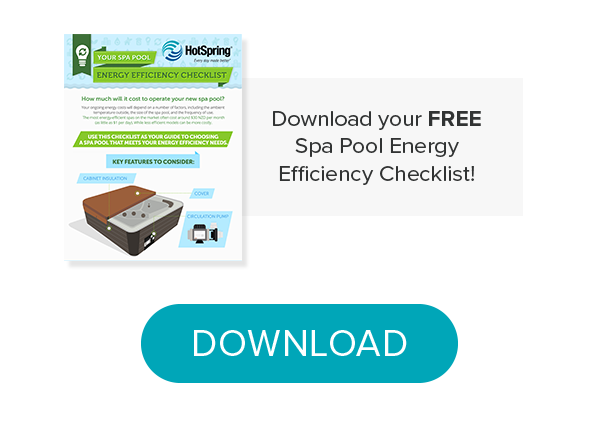
Energy efficiency should be right at the top of your checklist when choosing a spa. When something is energy efficient, it uses less power to do the same job, so it will cost you much less in the long run.
As New Zealand's most energy efficient spa brand, we should know. Our spa pools have running costs from as little as $1 per day so you can fully unwind, knowing that your relaxation isn't costing you the world.
Some companies highlight one feature of their spa to push the energy efficiency of their product. But if the spa hasn’t been designed to save energy across all features, the initial cost savings are lost with higher running costs. Are their spas well insulated? How often will you need to change the water? Are their spa covers effective?
You can see why it’s better to invest in a spa with components that contribute to its overall efficiency. It might cost a bit more upfront, but it will save you huge amounts in the long term. Other spas can be more than twice as expensive to run.
Every Hot Spring® Spa has been designed to save energy with:
- pumps that draws less power than a lightbulb
- multiple layers of high density foam that insulates a spa pool in a way no other spa manufacturers can
- tight-fitting custom-made spa covers with a high R-value
- low energy LED lights as standard in all models
- smart jets that only allow water pressure to be used where and when you need it – saving money and pump costs
- the heat radiated off the pumps being sucked up and transferred to the spa water
How does spa pool insulation impact monthly electricity costs?
While true energy efficiency can only be achieved when every aspect of your spa pool has been designed for the purpose, one characteristic has an outsized effect on performance: insulation.
The purpose of insulation is to reduce the rate of heat flow from the inside of the spa to the outside of the spa. There’s a wide variety of insulation technologies on the market, and some are far better than others – from basic partial and spray foam insulation found in cheap spa pools to the multi-density full foam insulation found in the high end spa pools in the Hot Spring range.
The higher the ‘R-value’ or performance of your spa pool insulation, the less heat will be lost, and the lower the running costs will be. It’s for this reason that choosing a more premium spa pool model can actually make more financial sense – not only will you enjoy a better soaking experience, the extra upfront cost can be paid off through lower power bills.
The difference quality insulation can make is massive: the best insulated spa pools can save owners $365 to $2,000 a year when compared to a poorly insulated equivalent.
Key takeaways
- Insulation is the single biggest driver of running costs.
- A higher R-value means less heat lost and a lower power bill.
- The best-insulated spas save owners $365 to $2,000 a year versus a poor equivalent.
How does spa covers affect monthly spa pool energy costs?
Insulation might be considered the most important factor in spa pool energy efficiency, but spa pool covers run a close second. There’s no faster way to lose heat from your spa pool water than to leave it uncovered. And even when the water is shielded, the quality of your cover can have a dramatic effect on how well your spa retains heat.
Spa pool covers aren’t just there to keep debris out of your spa. The best will feature high quality insulation and will be built specifically for your spa, in order to form a tight seal around the edges and avoid heat leakage.
Your ideal spa cover will also be built to last. Hot Spring spa covers are built to deal with your spa’s unique combination of warmth and moisture – they feature a non-permeable water barrier that protects the all-important insulation found within the cover. Add in our use of the highest quality materials, and our spa pool covers can last up to 3x longer than others!
Does where you put your spa affect running costs?
Your spa pool is in a constant battle with Mother Nature as it tries to avoid losing heat to the outside. The cooler the temperature outside, the harder the insulation has to work, and the easier it is for heat to leak out.
For the most part there’s not much you can do about ambient temperature: if you live somewhere cold, you live somewhere cold. This just increases the importance of choosing a spa pool with high performance insulation and a high quality cover, as these machines will hold in more heat no matter the temperature.
But there are a couple of smaller things you can do in terms of placement and installation to help your spa pool retain more heat. Where possible, place your spa pool somewhere that protects it from the worst of the elements, like in a nook under a verandah or patio. To avoid cold penetrating through the base of the spa, consider elevating it on a deck or insulating it by placing it on a high density foam mat.
How to run your spa pool efficiently
What’s the most energy efficient way to use your spa pool? The following tips and tricks could help you to save serious cash over the life of your spa:
- Choose wisely: If you haven’t yet purchased your spa pool, remember that an upfront investment in quality can more than pay itself back in the long run.
- Cover it up: Ensure you pop the cover on whenever your spa pool is not in use.
- Lower the temperature: Does the water temperature really need to be set to ‘MAX’? Not only can an extended soak in super hot water be dangerous, it can chew through huge amounts of electricity. Try a temperature in the mid-to-low thirties instead.
- Stay on top of maintenance: Your spa pool will only be able to perform at its peak if you take care of it. Ensure the filters are empty, the machinery is serviced, the water is cared for and the machine is generally clean.
- Keep it on (if you have a Hot Spring!): Hot Spring spa pools are high performance, energy efficient spas with running costs as little as $1 a day. They’re so efficient, in fact, that keeping your water heated 24/7 can actually use less energy than turning it off then heating it back up again!
How to heat your spa efficiently
Heating the water is your spa pool’s most energy-intensive task. But there are some ways that you can help your machine with this heavy lifting.
First, it’s once again beneficial to have chosen the right spa pool – one that features high quality components that warm the water quickly, and that is well insulated so won’t lose much heat in the process. Beyond that, you can heat your spa water more efficiently by:
- Ensuring the cover is on and tightly sealed.
- Heating your spa pool during the warmest part of the day.
- Turning the jets on… if your spa pool features Hot Spring hot air induction jets. These clever jets recycle heat from the insulated equipment compartment, injecting this excess heat back into the water!
How much does it usually cost to heat a spa pool in winter?
Heating costs rise in winter because your spa works harder against the cold, so insulation and cover quality matter most in the colder months. In practice, a well-insulated spa pool still runs efficiently year round, while a poorly insulated one can double its bills once temperatures drop.
A Hot Spring holds heat with Edge-to-Edge Insulation, an insulated cover and hot air induction jets that recycle warmth back into the water, so running costs stay close to that $1 a day figure even through a Wellington winter. The bigger winter risk is a cheap spa: thin insulation means the heater runs almost constantly to hold temperature.
How to insulate your spa pool efficiently
Sure, the spa pool manufacturer is the one in charge of ensuring your spa is well insulated inside the cabinet, but is there anything that you, the owner, can do to help your spa pool retain more heat?
If we use a slightly broader definition for insulation, the following tips can help to keep the warmth inside you spa pool, where it’s most useful:
- Place your spa in a protected area: ‘Insulate’ your spa from the elements by placing it in a semi-enclosed space that protects it from wind, rain, hail and snow.
- Keep it off the ground: In cold climates your spa pool can lose quite a bit of heat through its base. Consider elevating it off the earth by placing it on a deck or on top of a foam mat.
- Cover, cover, cover: We’ve said it before and we’ll say it again, always keep your spa pool covered when not in use.
How can you check a spa's real running costs before you buy?
You’ll want to know the long-term costs of a spa upfront and it’s important that any claims made on the sales floor can be backed up. The size and model of the spa, as well as the ambient temperature outside the spa, contribute to the running cost. Any sales person who gives you an estimate without knowing your details isn't necessarily giving you good information.
An example: The average cost of powering a spa pool in Auckland is approximately 96 cents per day, or $6.72 per week. These figures are based on an average-sized spa pool, running in the average Auckland temperature of 15.1 degrees, and using power at the average cost of 19.16 cents per kilowatt hour.
A lot of manufacturers advertise that their spas cost ‘a dollar per day’ to run, but such a sweeping statement doesn’t take into account all the variables that contribute to electricity use. In Wellington, a colder city than Auckland with higher power prices, a spa pool might cost up to $10 per week or even $50 per month to run.

At Hot Spring, we solve this problem by using a third party to test our spas and research power prices and average temperatures across New Zealand. That information gives us a way to accurately estimate running costs in different parts of the country. We also have an online energy calculator that can give you an estimate of the running costs by spa model, climate and energy rate.
Key takeaways
- Ask any salesperson to back up running-cost claims against your model, size and local climate.
- Auckland averages about 96 cents a day; colder Wellington can reach $10 a week.
- Rely on an independently tested figure or the energy calculator, not a vague "dollar a day".
Frequently asked questions on spa pool running cost
Does a spa pool add value to your home?
A quality spa pool can add lifestyle appeal that helps a property stand out, though it is best viewed as a wellness investment rather than a guaranteed resale return. A portable, self-contained spa also travels with you if you move, unlike an in-ground pool.
What hidden costs should I budget for beyond the purchase price?
Beyond the spa itself, budget for electrical preparation, delivery and any crane or hiab access, starter water care, and steps or a cover lifter. Ongoing costs are power, water top-ups and chemicals, plus occasional servicing.
Do I need a special power supply or an electrician to install a spa pool?
Most spa pools need a dedicated circuit installed by a registered electrician. Your Hot Spring dealer can confirm the exact power requirement for your model before delivery.
Can I run a spa pool on solar power?
Yes, an efficient spa pool pairs well with home solar because its biggest draw is heating. The lower a spa's running cost, the more of it your panels can offset.
How often will I need to replace the water, and what does that cost?
With smart water care, Hot Spring water lasts up to four times longer than many spas, so you drain and refill less often. Fewer refills mean lower water and chemical costs over the year.
How long does a quality spa pool last?
A well-built, well-maintained spa pool can last many years, potentially decades, while a cheaper machine may need replacing several times over the same period. Insulation quality and build materials are the main factors.
Buy a spa pool from people you can trust
If you’re looking to purchase a spa pool, a more urgent cost to consider is the upfront price. Your first decision will be whether to choose a permanent in-ground or portable above-ground spa. Between council permission, excavation, installation and landscaping, in-ground spas can be a pricey affair, costing $50,000 or more. Hot Spring’s portable, self-contained spas, meanwhile, can simply be placed, filled and plugged in, dramatically lowering upfront costs.
A spa is a big purchase, so you need to trust that the people you're buying from are giving you good advice. Unfortunately, this isn't always the case. With a Consumer NZ report finding that some spa pools can cost $25 a week to run, it’s important to understand the full cost that could be hiding behind a good deal.
Aaron Sampson, Hot Spring Spas NZ General Manager, explains: “The issue we’ve got in our industry is that no spa company is going to tell you their pools are expensive to run. It’s not until the consumer gets their spa home that they see what the operating costs are.”
At Hot Spring, we believe an honest approach is the best way to keep our customers coming back.
Aaron says, “When people buy a cheap spa pool then get stung by high running costs, it’s a bad experience. They’ll never buy another spa and they’ll tell their friends not to as well .”
Hot Spring have been building our customers’ trust since 1980, and we're proud to offer the Absolute Best Spa Pool Ownership Experience™.
For an energy-efficient spa contact your local Hot Spring team near you or chat with us online now.